
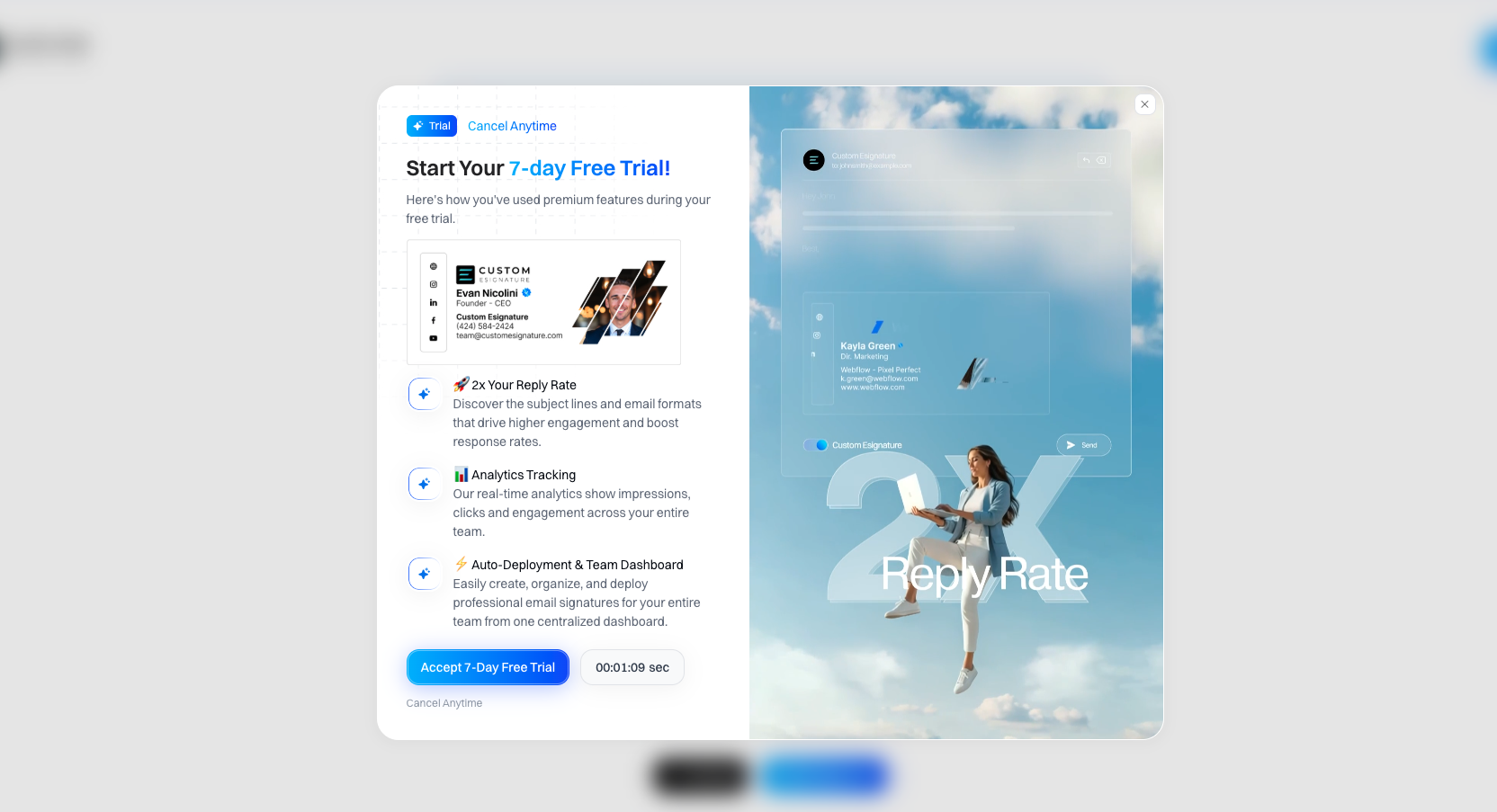
In a product-led growth model, the checkout moment is everything. You've already won the hardest battle — a user found your product, tried it, and decided it was worth paying for. They're on the upgrade screen. And then they leave.
For most PLG startups, checkout abandonment rates hover between 60% and 80%. That number is brutal when you consider the acquisition cost already baked into every user who made it that far. The problem usually isn't price. It's hesitation — unresolved questions, unclear value, or a final-moment comparison reflex that sends them to a competitor's site to double-check.
Custom Esignature, a product-led e-signature platform built for small businesses and freelancers, identified this exact pattern in their conversion funnel and responded with a precise, layered popup strategy at the checkout stage.
Custom Esignature is a PLG startup competing in the e-signature space against category giants. Their differentiation is simplicity and brand customization — users can upload their own logo, set brand colors, and send fully white-labeled signature requests without touching a line of code. Their free tier is generous, which means the free-to-paid conversion rate is the most critical metric in the business.
Their checkout flow is where free trial users decide whether to upgrade to a paid plan. It's a high-stakes page, and for a long time, it was underperforming relative to the quality of users reaching it.
Rather than a single intervention, Custom Esignature built a sequenced popup strategy that addresses three distinct objections at different points in the checkout flow.
When a user lands on the upgrade/checkout page, a lightweight banner popup appears at the bottom of the screen — not an intrusive modal, but a subtle trust signal: a rotating carousel of recent customer reviews with star ratings and a line of copy tying the review to the plan being considered. This fires within 3 seconds of page load and is dismissible with one click.
Effect: Reduced immediate checkout page exits by 18%.
When a user hovers over a paid plan for more than 4 seconds without clicking — a signal of hesitation — a small contextual popup appears adjacent to the plan card. It contains three bullet points: the top three features unlocked by upgrading, a line showing estimated time savings per month, and the price broken down to a daily cost ("less than a coffee").
Effect: 22% increase in plan selection clicks among users who triggered the hover popup.
For users who move their cursor toward the browser's close button or address bar, an exit-intent popup fires with a time-limited offer: a first-month discount or an extended trial. The copy is direct: "Before you go — lock in [X]% off your first month. Offer expires in 10 minutes."
Effect: 9.4% of users who triggered the exit-intent popup converted within the session.
Across the three-popup sequence, Custom Esignature reported the following outcomes after 60 days of deployment:
These results align with broader PLG conversion research. According to data from ProductLed and OpenView Partners, PLG companies that deploy contextual in-product messaging at the upgrade moment see an average 40–70% improvement in free-to-paid conversion rates compared to those relying solely on email nurture.
There's an important distinction between popups used for lead capture (converting anonymous visitors into email subscribers) and checkout popups designed to convert already-engaged users. The psychology is different.
At checkout, the user has already invested time in your product. The popup isn't introducing them to something new — it's resolving residual hesitation. The job of a checkout popup is to:
Custom Esignature's approach works because each popup is designed for a specific hesitation type, not for a generic conversion goal. The hover popup speaks to users who don't fully understand what they're buying. The exit-intent popup speaks to users who understand it but are stalling on price.
If you're running a PLG product and haven't pressure-tested your checkout flow with behavioral popups, the opportunity cost is significant. Here's a simplified implementation framework based on what Custom Esignature built:
Step 1: Map your checkout drop-off with session recording tools. Identify where users are leaving and what hesitation signals (hover, scroll back, idle time) precede exits.
Step 2: Match popup type to hesitation signal. Idle time = value gap. Hover = unclear features. Cursor-to-browser = price resistance or comparison intent.
Step 3: Write one job per popup. Each popup should do exactly one thing: reinforce, clarify, or incentivize. Multi-message popups reduce conversion.
Step 4: A/B test exit-intent offers. Discounts outperform extended trials for monthly plan conversions. Extended trials outperform discounts for annual plan conversions.
A checkout popup is a behavior-triggered overlay or banner that appears during the upgrade or payment flow of a product-led growth application. Unlike awareness popups on marketing pages, checkout popups are designed to resolve purchase hesitation from users who have already experienced the product and are actively considering an upgrade.
Median free-to-paid conversion rates for PLG B2B companies range from 2% to 5%, according to OpenView Partners benchmarks. Top-quartile performers achieve 7–15%, often through optimized in-product upgrade flows that include contextual messaging, social proof, and behavioral triggers at the moment of purchase intent.
Yes. E-signature products have naturally high trial engagement (users sign or send at least one document) but face hesitation at upgrade because the category feels commoditized. Checkout popups that reinforce brand differentiation — like Custom Esignature's white-labeling features — are especially effective because they remind users of the specific value that competitors don't offer.


.svg)