ABM Website Personalization for Enterprise Sales Teams
ABM website personalization means dynamically changing what a target account sees on your website — headlines, case studies, pricing, and CTAs — based on who they are and what deal stage they're in. For enterprise sales teams running account-based programs, it closes the gap between a hyper-targeted outbound sequence and a generic homepage that treats a $200K prospect the same as an anonymous blog reader.
Most enterprise ABM programs invest heavily in personalized outreach — custom decks, tailored emails, account research — and then send every one of those prospects to the exact same homepage. That mismatch is expensive. A VP who clicks through from a hyper-personalized email expects the same relevance on your site; when generic messaging greets them instead, sales has to re-earn attention it already had.
Why Generic Websites Undercut Enterprise ABM Programs
Your website is the highest-intent touchpoint in the funnel, but for most companies it's also the least personalized one. This is the core argument for B2B website personalization as an ABM discipline, not just a marketing nicety.
How ABM Website Personalization Actually Works
1. Account Identification
Personalization starts with knowing who's on the page. Upvert's website de-anonymization matches visiting IP addresses and firmographic signals against a company database in real time, resolving anonymous traffic to a named account before the visitor takes a single action. Corporate networks resolve far more reliably than residential or mobile connections, but B2B SaaS sites typically identify company-level visits for a meaningful share of traffic within the first session.
2. Dynamic Microsite Generation
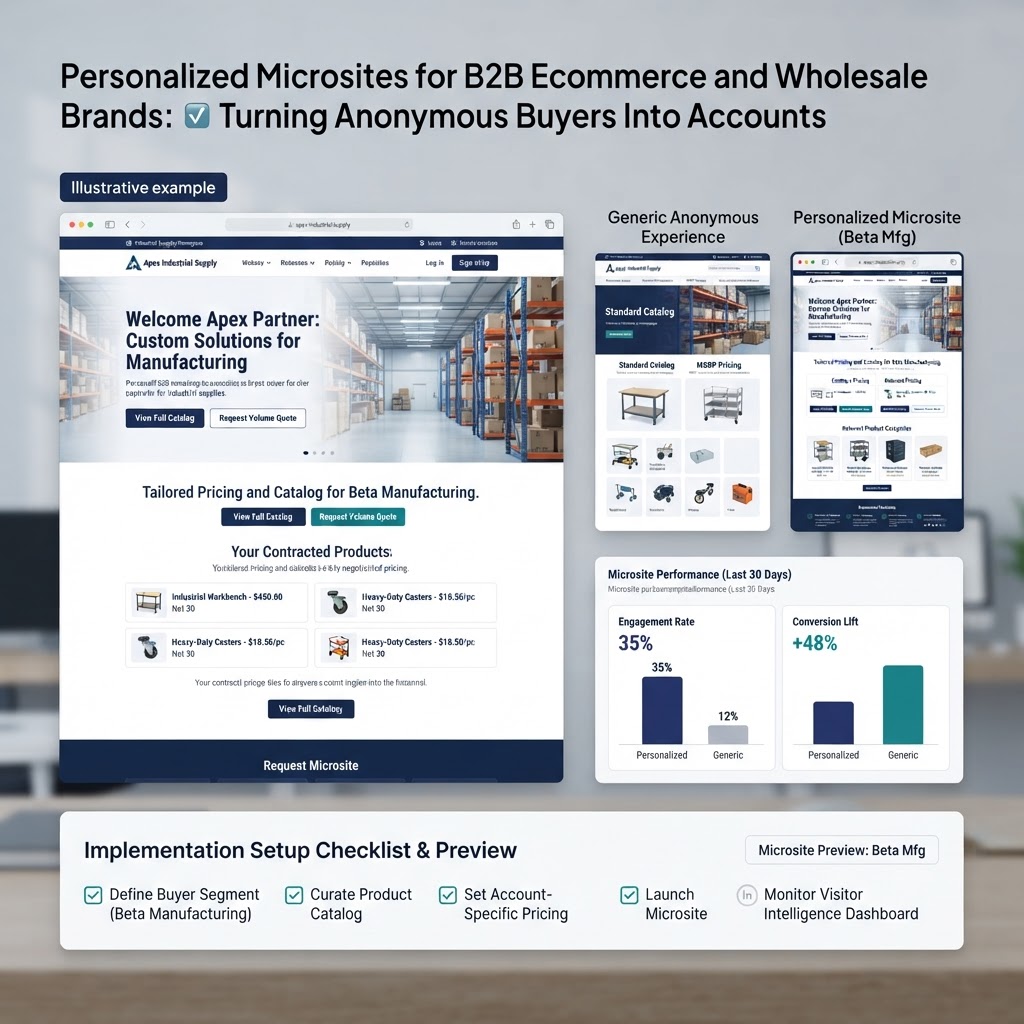
Once an account is identified — or arrives via a UTM-tagged sequence, ABM ad platform, or CRM-triggered link — Upvert's personalized microsites swap in account-specific content: the target company's logo, industry-relevant case studies, a headline referencing their vertical, and a CTA tied to deal stage. Microsites can be built per segment or, for strategic accounts, per named company.
3. Real-Time Personalization Triggers
Intent-triggered popups fire based on scroll depth, time on page, or account tier, surfacing a tailored CTA exactly when engagement peaks rather than on a blanket timer.
What to Personalize First
A practical rollout prioritizes: named target accounts already in active outbound sequences, accounts de-anonymized visiting pricing or competitor pages, and segments defined by industry or size where one templated microsite variant serves dozens of accounts at once. Enterprise teams typically start with 3–10 microsite variants mapped to their top ABM tiers before expanding to 1:1 experiences for their highest-value accounts.
Measuring ABM Website Personalization ROI
For ABM specifically, the more useful metric isn't top-of-funnel conversion — it's account engagement velocity: time from first identified visit to a booked meeting, and the percentage of target accounts that re-engage with the site after an outbound touch.
Getting Started
ABM website personalization works best as a closed loop: de-anonymize the account, personalize the experience, and route the resulting intent signal back to your CRM so sales can follow up while it's warm. Upvert connects natively with HubSpot and via webhook to Salesforce, Outreach, and Apollo, so this loop runs without manual list-pulling.
Frequently Asked Questions
ABM website personalization is the practice of dynamically changing website content — messaging, case studies, pricing, and calls-to-action — based on the identity, industry, or deal stage of the specific target account visiting the site, rather than showing every visitor the same generic page.
De-anonymization identifies the company behind an anonymous website visit using IP and firmographic matching. For ABM, this lets sales and marketing know the moment a target account is on the site — even if they never fill out a form — so personalization and outreach can happen in real time.
No. Most enterprise teams start with a handful of microsite templates built around ABM tiers, industries, or deal stages, then build fully 1:1 microsites only for their highest-value strategic accounts.
Because Upvert requires no engineering work to launch microsites or popups, most teams can go from account list to a live personalized campaign within days.
Personalized pages can convert up to 80% higher than generic equivalents, and intent-triggered popups typically convert at 4–5%+, compared to the 1–2% average for standard B2B websites.
ABM programs that personalize outreach but not the website leave conversion on the table. De-anonymization plus microsites closes that gap without engineering resources.
See ABM personalization against your own target accounts — book a demo or start a free trial of Upvert.