Personalized Microsites for EdTech Companies: Turning Anonymous District and University Visits Into Sales Conversations
Short answer: Personalized microsites let EdTech companies show a different, tailored version of their website to each school district, university, or state agency that visits — using website de-anonymization to identify the account and swap in relevant case studies, pricing tiers, and CTAs automatically. Because EdTech buying committees are large (curriculum leads, IT, procurement, superintendents) and sales cycles stretch across school-year budget calendars, a generic homepage rarely speaks to the specific stakeholder currently on the page. Microsites close that gap without requiring a developer to build a new page for every account.
Why EdTech Buying Committees Are Hard to Market To
A single K-12 software deal can involve five or more stakeholders across curriculum, IT, special education, procurement, and the superintendent's office — often researching independently, months apart, and anonymously. By the time someone fills out a demo form, most of the buying committee has already formed an opinion of your product from a generic homepage that never addressed their specific role, district size, or use case.
How Personalized Microsites Work for EdTech
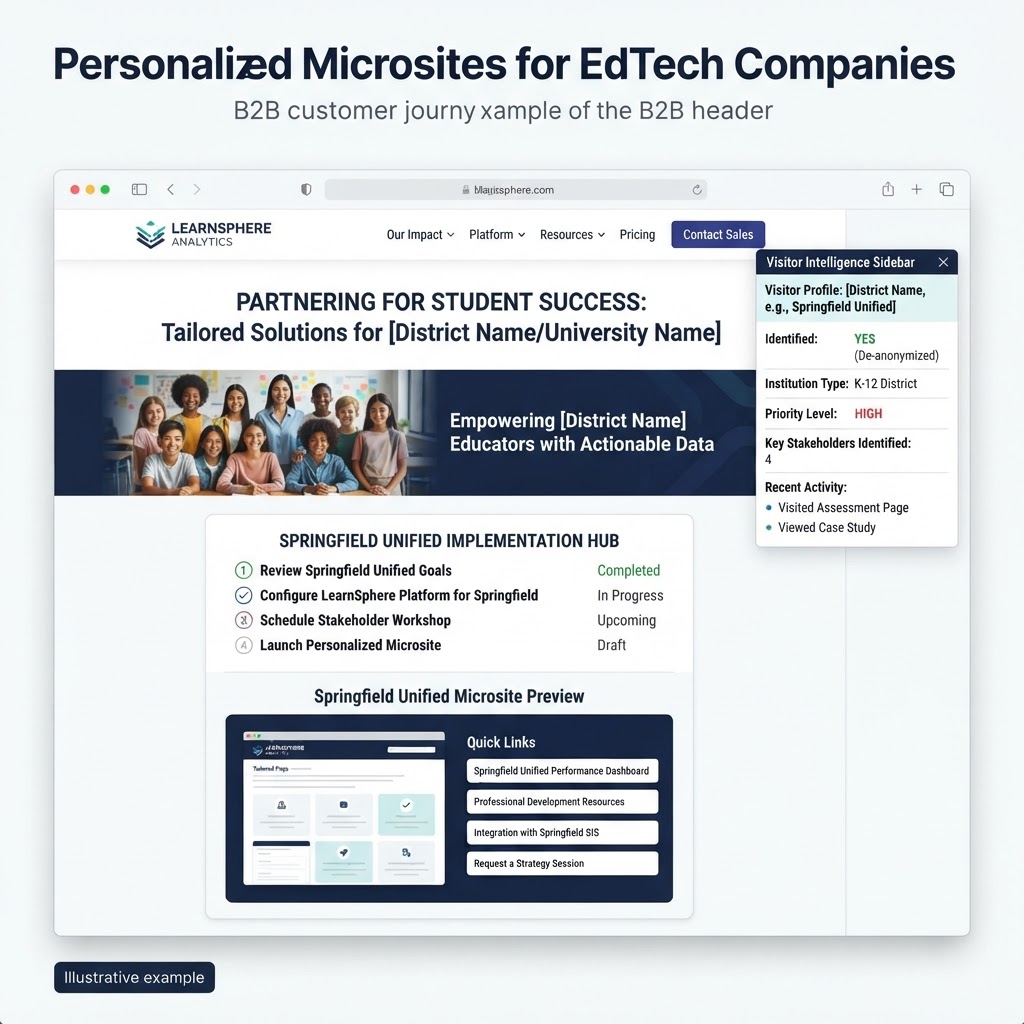
Upvert builds a personalized microsite for each identified account or segment: swap the hero headline for a district's name and enrollment size, surface a case study from a comparable district, adjust pricing messaging for K-12 vs. higher-ed procurement, and route the CTA toward the right next step. These pages are generated and updated per segment or account without custom development, so a marketing team — not engineering — owns the experience.
De-Anonymizing District and University Traffic
Before a microsite can personalize anything, Upvert first has to know who's on the page. Website de-anonymization matches the visitor's IP address to an organization using reverse DNS and firmographic databases, then layers in person-level identification through Upvert's partnership with Warmly where signals allow. For EdTech specifically, this means catching a visit from a district's central office network or a university's administrative IP range and mapping it to a named account — even if no one has filled out a form.
A Practical EdTech Microsite Playbook
- State- or region-specific pages: surface funding sources, compliance standards, or case studies relevant to a visitor's state the moment de-anonymization identifies their district.
- K-12 vs. higher-ed differentiation: route university IT departments to integration and SSO content, and K-12 curriculum leads to instructional-fit content, from the same top-of-funnel traffic.
- RFP-specific landing pages: when a known district is actively evaluating an RFP, personalize the microsite with the exact proof points procurement is scoring against.
Pairing Microsites with Intent-Triggered Popups
Microsites handle the page itself; Smart Popups handle the moment-to-moment nudge — firing based on scroll depth, time-on-page, or account tier to invite a known district's curriculum lead to book a call, or to surface a relevant case study to a first-time visitor from a new account. Used together, de-anonymization identifies the visitor, the microsite personalizes the page, and the popup prompts the next step — all without manual segmentation.
Frequently Asked Questions
What is a personalized microsite?
A personalized microsite is a webpage automatically customized for a specific account, segment, or visitor — swapping headlines, case studies, pricing, and calls-to-action based on who Upvert has identified through website de-anonymization, without requiring a new page to be built by hand for each account.
How does website de-anonymization identify a school district or university?
Upvert matches the visitor's IP address to an organization using reverse DNS lookups and firmographic databases, and adds person-level identification through its partnership with Warmly where available, so a visit from a district's or university's network can be mapped to a named account even before a form is filled out.
Do EdTech companies need developers to build microsites?
No. Upvert's microsites are built and updated by marketing teams directly, with personalization rules applied per segment or account, so new pages don't require an engineering sprint.
How is this different from a generic landing page builder?
A generic landing page shows the same content to every visitor. A personalized microsite changes its content based on who's viewing it — the district, the buying stage, and the account tier — using real-time de-anonymization instead of manual list segmentation.
See how a personalized microsite would look for your top accounts — book a demo or start for free.