Privacy-Compliant Website Visitor Identification: A GDPR and CCPA Guide for B2B Teams in 2026
Short answer: You can identify B2B website visitors responsibly by prioritizing company-level matching, honoring consent and opt-out signals, storing as little personal data as possible, and choosing vendors that document where their data comes from. Person-level identification is higher risk and deserves a legal review before launch. This article is general information, not legal advice.
Why Privacy Is Now a Buying Criterion
As third-party cookies decline and AI-assisted browsing hides more of the buyer journey, B2B teams are leaning harder on first-party signals. At the same time, privacy regulation keeps expanding: GDPR in the EU and UK, CCPA/CPRA in California, and a growing list of US state laws. Procurement and security teams now routinely ask visitor-identification vendors how their data is sourced and how opt-outs are handled. Getting ahead of those questions shortens deal cycles on both sides.
Company-Level vs. Person-Level Identification
The most important distinction is what you identify.
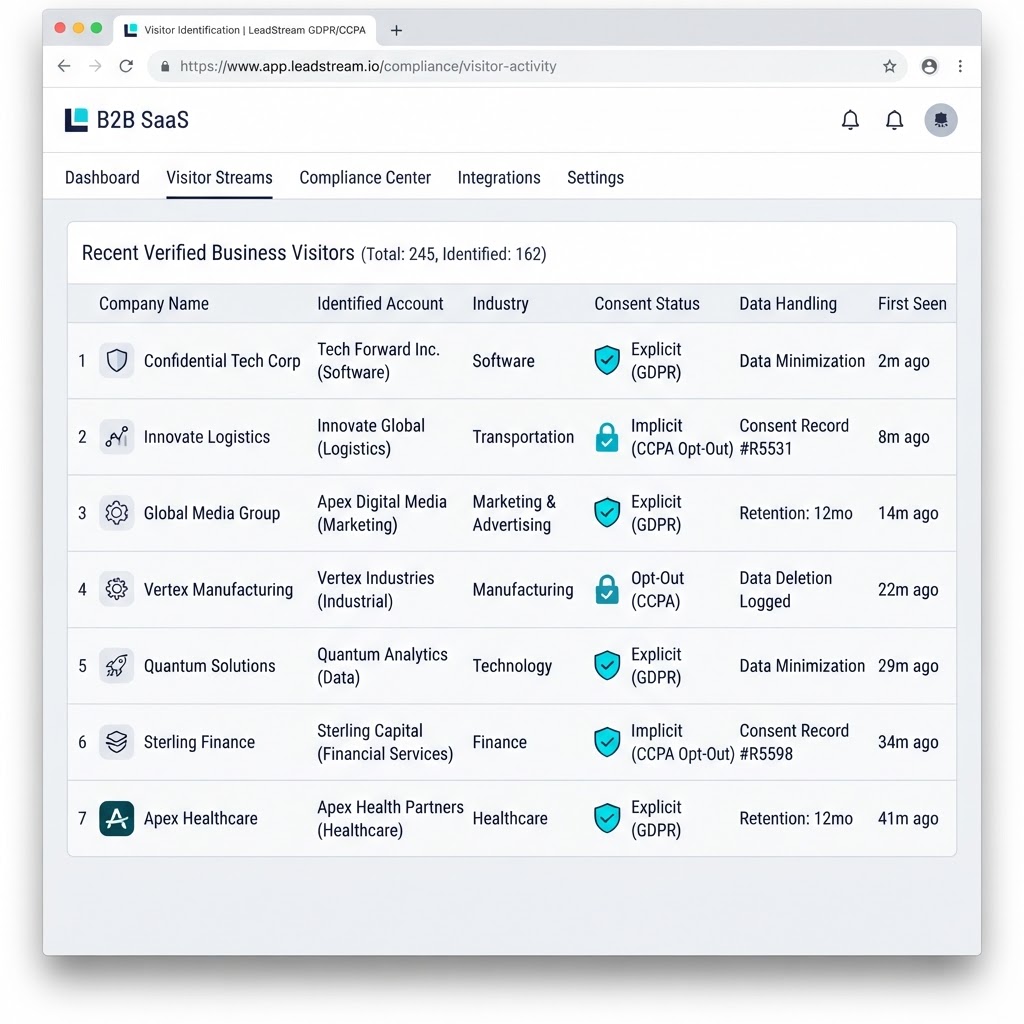
- Company-level identification resolves a visit to an organization using IP-to-company matching and reverse DNS. It tells you that a 200-person logistics company is reading your pricing page, without naming an individual.
- Person-level identification attempts to resolve an individual, usually through identity-resolution partners. Upvert offers this through its partnership with Warmly. It is more actionable for outreach, and also more sensitive from a privacy standpoint.
Many teams start at the company level, which supports account-based plays with a lighter compliance footprint, then add person-level data only for regions and use cases their counsel has approved. For a deeper comparison, see company vs. person-level de-anonymization.
Five Practices That Keep Identification Defensible
1. Honor consent and opt-out signals
Respect your consent management platform, Global Privacy Control signals where applicable, and "do not sell or share" preferences. Only fire identification and tracking scripts when the visitor's choices allow it, and make sure the setting is tested in every region you serve.
2. Minimize what you store
Keep only the fields sales actually uses, such as company name, industry, size, and pages viewed. Avoid hoarding raw IP addresses or unneeded personal attributes, and set a retention window with automatic deletion.
3. Be transparent in your privacy policy
State that you use visitor-identification and analytics tools, what categories of data are collected, the purpose, and how to opt out. Plain language builds trust and satisfies disclosure requirements.
4. Segment regions deliberately
Many teams limit person-level identification to jurisdictions where they have a clear legal basis and run company-level or first-party-only experiences elsewhere. Region-aware rules keep one policy from breaking another.
5. Vet the vendor, not just the demo
Ask where match data originates, how often it is refreshed, how deletion and opt-out requests propagate, and whether the vendor will sign a data processing agreement. A vendor that cannot answer clearly is a risk.
Using Identification to Improve Experience, Not Just Outreach
Privacy-conscious teams often get the most value by using identification to improve what visitors see rather than to chase them. Intent-triggered popups can fire on first-party behavior such as page depth, time-on-page, scroll percentage, and exit intent, and personalized microsites can adapt messaging by segment or account tier. These experiences work on the page itself and reduce the need to push data into aggressive outbound sequences.
A Quick Vendor Due-Diligence Checklist
- Documented data sources and match methodology
- Opt-out and deletion workflows that propagate downstream
- Region controls and consent-aware script loading
- Data processing agreement and security documentation
- Clear retention settings and CRM sync controls (for example HubSpot and Salesforce)
Frequently Asked Questions
Is website de-anonymization legal?
It depends on what you identify, where the visitor is, and how you obtain consent and disclose the practice. Company-level matching is generally considered lower risk than person-level identification, but you should confirm with qualified counsel.
Does GDPR apply to IP address matching?
IP addresses can be treated as personal data under GDPR in many contexts. Teams commonly address this with consent management, minimization, and a documented legal basis.
Can I identify visitors who decline cookies?
You should respect their choice. Configure identification and tracking scripts to follow your consent platform and opt-out signals rather than working around them.
What should I ask a visitor-identification vendor about privacy?
Ask about data sources, refresh cadence, opt-out and deletion handling, regional controls, and whether they will sign a data processing agreement.
Want to see how Upvert handles identification, popups, and microsites together? Book a demo or start for free. See pricing.