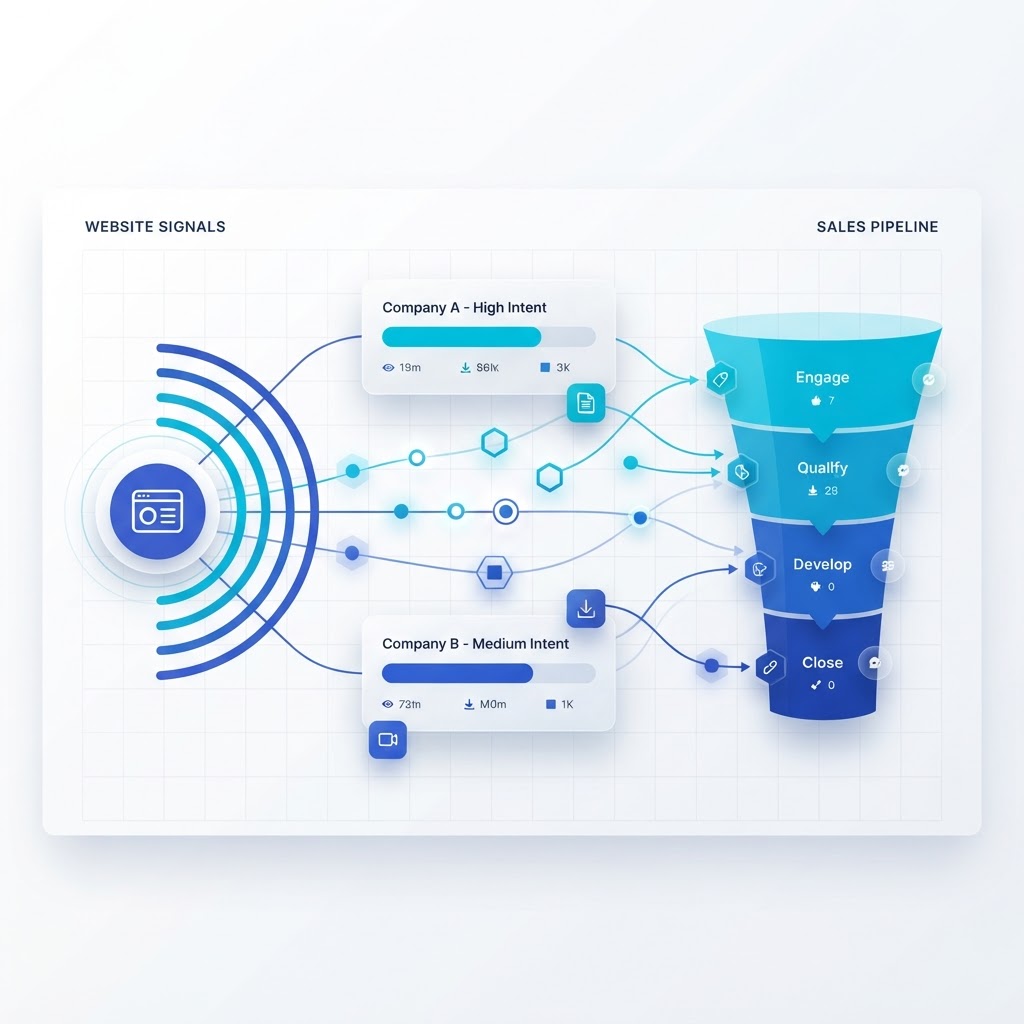
First-Party Intent Data for RevOps: Turning Website Signals Into Prioritized Pipeline
First-party intent data is behavioral and identity signal collected directly from your own website — page depth, return visits, pricing page views, and de-anonymized company identity — rather than purchased third-party data. RevOps teams use it to score and route accounts in real time, and Upvert customers typically see qualified leads flowing into their CRM within hours of installation, with no dependency on cookies or ad-network data that AI browsing agents increasingly bypass.
Every RevOps leader has the same monthly ritual: reconcile a lead-scoring model built on stale firmographic data against a pipeline number that keeps missing forecast. The problem usually isn't the scoring model. It's the inputs. Most B2B teams are still prioritizing accounts based on data that's purchased, delayed, or increasingly invisible.
Why Third-Party Signals Are Losing Ground in 2026
Two forces are converging to make first-party website signal collection non-negotiable for RevOps in 2026. First, privacy regulation and browser changes have steadily degraded third-party cookie tracking. Second — and more urgent — a growing share of B2B research now happens through AI agents rather than direct browser sessions. Buyers ask ChatGPT or Perplexity to shortlist vendors, compare pricing, and summarize reviews before a human ever loads your homepage, which means the pageview-and-click behavioral data RevOps has relied on for a decade is quietly shrinking as a share of total buyer research activity.
That shift makes the signal you do capture — the direct, first-party visit to your own domain — more valuable, not less. It's the moment a real buyer, or their agent, has entered your owned environment. The question is whether your stack is built to recognize and act on it.
What First-Party Intent Data Actually Includes
First-party intent data is any signal your own website, product, or app collects directly from a visitor's interaction — without relying on a third-party data broker. For B2B RevOps teams, the highest-value first-party signals are:
- Company-level identity — resolving an anonymous visit to a real company using website de-anonymization, typically via reverse IP lookup and identity-resolution partnerships.
- Page depth and path — how many pages a visitor viewed and which ones (pricing, case studies, integrations pages carry more signal than a blog post).
- Return visit frequency — a company returning within a 7-day window is a materially stronger buying signal than a single session.
- Time-on-page and scroll depth on high-intent pages like pricing or product comparison content.
- Popup and microsite engagement — whether a visitor interacted with a targeted offer, which is itself a first-party behavioral data point.
The RevOps Prioritization Model: From Signal to SQL
The teams getting this right run a simple, repeatable model rather than a black-box score:
- Identify. De-anonymize the visit to company-level identity in real time — Upvert customers typically resolve 40–60% of B2B traffic to a named company, depending on industry and traffic mix.
- Qualify. Match the identified company against ICP criteria: employee count, industry, tech stack signals, and existing CRM stage.
- Score. Weight the visit using page depth, return frequency, and pricing-page engagement — not just firmographic fit alone.
- Route. Push qualifying accounts to Salesforce or HubSpot with the triggering page and visit history attached, so reps have real context instead of a cold list.
- Engage. Trigger an intent-triggered popup or personalized microsite in the same session to capture the visitor before they leave, rather than waiting for a follow-up email days later.
The full loop — identify to route — can run in under a minute per visitor when de-anonymization and CRM sync are connected through native HubSpot and Salesforce integrations, which is a meaningful compression from the days-long lag typical of third-party intent data providers.
What the Data Says About Intent-Driven Prioritization
These figures, from Markettailor's 2026 State of B2B Personalization report, reinforce what RevOps teams already suspect: the bottleneck isn't a lack of intent signal, it's the integration gap between capturing signal and routing it into a rep's queue fast enough to matter. That integration gap is exactly what a first-party, real-time de-anonymization layer is built to close.
Frequently Asked Questions
First-party intent data is collected directly from your own website, product, or app — page visits, engagement, and identity resolved from your own traffic. Third-party intent data is aggregated by an external vendor from a network of publisher sites and sold to multiple buyers, often with a data lag of days and no direct visibility into which specific page or moment triggered the signal.
With a real-time de-anonymization and routing setup, qualifying visits can be identified, scored, and pushed to a CRM within minutes of the visit. Upvert customers typically see their first identified leads within hours of installing the tracking script, and full automated routing live within a day.
As more B2B research shifts to AI assistants like ChatGPT and Perplexity, traditional session-based analytics capture a shrinking share of the buyer journey. First-party signals captured the moment a buyer (or their agent) reaches your own domain remain reliable and directly actionable, regardless of how much research happened upstream in an AI tool.
No. Growth-stage B2B companies with meaningful website traffic but lean sales teams typically see the highest proportional benefit, since intent-based prioritization lets a small team focus outreach on the accounts most likely to convert instead of working every inbound lead equally.
First-party intent data — company identity, page depth, and return visits captured directly from your own site — is the highest-signal, lowest-latency input available to RevOps in 2026. Pair it with real-time routing and on-site engagement, and prioritization stops being a monthly modeling exercise and becomes a live operating system for pipeline.
See how Upvert's de-anonymization and popup engine can plug first-party intent directly into your CRM — book a demo or start a free trial.