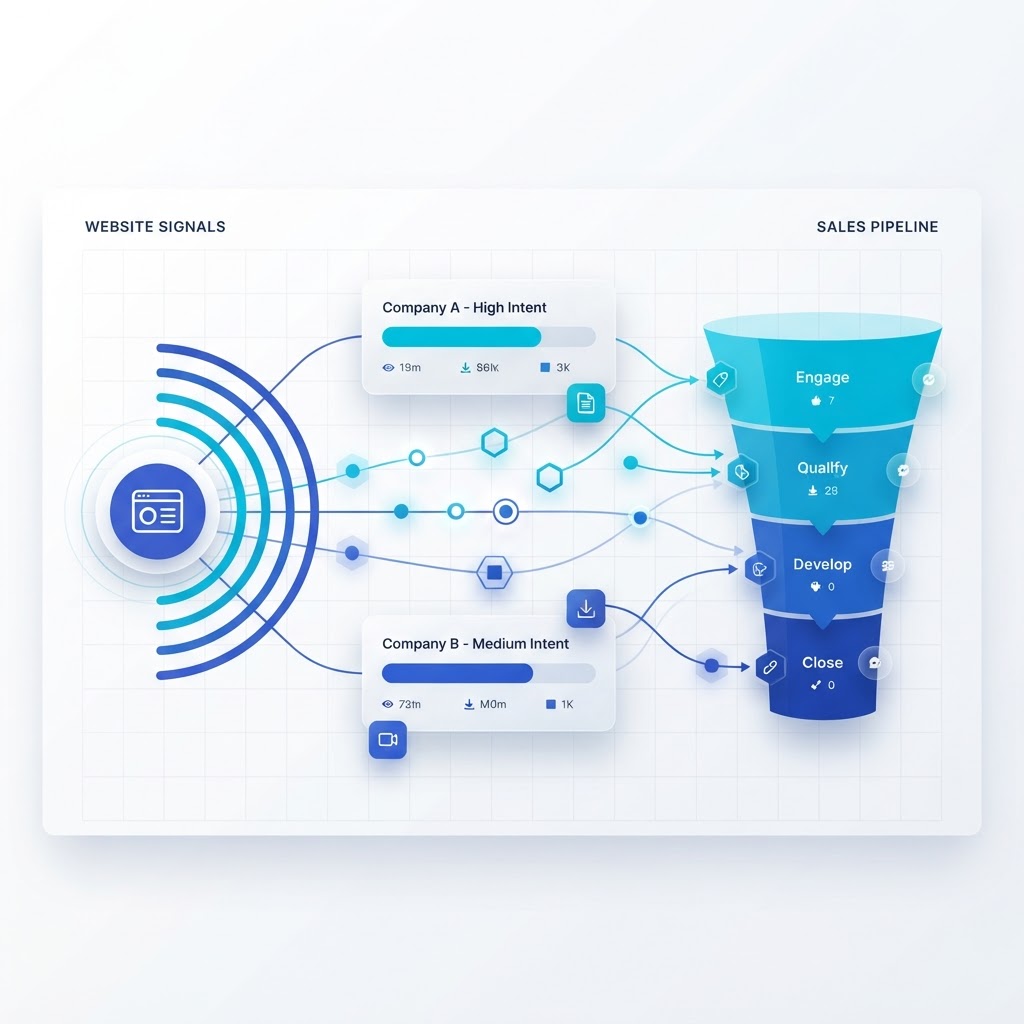
How Website De-Anonymization Match Rates Actually Work
Website de-anonymization match rate is the percentage of anonymous visitors a tool successfully resolves to a real company or contact. It's driven by layering reverse IP/company matching, reverse DNS lookups, and identity-resolution network data — Upvert, powered in part by Warmly's identity graph, typically resolves 40–60% of B2B website traffic to company-level identity, with person-level match rates lower and more dependent on the visitor's own opt-in data trail.
"What's your match rate?" is the first question every RevOps or demand gen leader asks when evaluating a de-anonymization tool — and it's usually followed by a second, more important question: match rate compared to what, and measured how? This guide breaks down the actual mechanics behind the number, so you can evaluate any vendor's claim with a technical eye.
The Three Layers of Identity Resolution
No single method resolves every visitor. Modern website de-anonymization stacks three complementary layers:
1. Reverse IP / Company-Level Matching
Every visitor's device connects through an IP address. Reverse IP matching checks that address against a database of known corporate IP ranges — data center blocks, ISP allocations tied to specific businesses, and static office network ranges. This is the foundation layer and works well for visitors on a corporate office network, but it struggles with remote workers, mobile connections, and VPN traffic, all of which route through generic or masked IP ranges.
2. Reverse DNS and Network Fingerprinting
Reverse DNS lookup resolves an IP address back to a hostname, which can reveal the organization operating that network block even when it isn't in a standard corporate IP database. Combined with device and browser fingerprinting signals, this layer catches a meaningful share of visitors that pure IP-range matching misses — particularly at mid-size companies with less standardized network infrastructure.
3. Identity-Resolution Network Partnerships
The highest-accuracy layer comes from identity-resolution partners that maintain opt-in and cross-referenced identity graphs — matching device and browser signals against a broader network of known professional identities. Upvert's integration with Warmly's identity network is an example: rather than relying on IP data alone, it cross-references signals across a shared identity graph to improve match confidence, which matters most in the hybrid-work era, where a large share of B2B visitors aren't on a traditional office network at all.
Company-Level vs. Person-Level Identification
| Resolution type | What you get | Typical match rate | Best for |
|---|---|---|---|
| Company-level | Company name, industry, size, tech stack | 40–60% of B2B traffic | Account scoring, ABM targeting, popup personalization |
| Person-level | Name, title, email of the individual visitor | Typically 10–25%, vendor-dependent | Direct outreach, sales handoff, 1:1 follow-up |
Most B2B teams should treat company-level identification as the reliable baseline and person-level as a valuable bonus layer rather than the headline metric — a vendor promising high person-level match rates across all traffic is a signal worth scrutinizing closely.
What Moves the Number Up or Down
Match rate isn't a fixed property of a tool — it varies by traffic source and audience. Four factors matter most:
- Traffic source: Paid search and direct traffic typically match higher than organic social, where mobile and app-embedded browsers dominate.
- Remote vs. office work mix: Visitors on corporate VPNs or office networks resolve more reliably than remote workers on home ISP connections.
- Industry vertical: Enterprise and mid-market B2B buyers resolve at higher rates than consumer-adjacent or SMB-heavy audiences.
- Geography: Match rates are generally strongest in the US, UK, and other markets where identity-resolution data networks have the deepest coverage.
A realistic implementation timeline: most teams have Upvert's tracking script live and identifying visitors within an hour of installation, with match rate stabilizing to its steady-state range within the first week of traffic.
How to Evaluate a Vendor's Match Rate Claim
When a vendor quotes a match rate, ask three questions: Is this company-level or person-level? Is it measured against total sessions or unique visitors? And does the number include or exclude bot and non-human traffic, which artificially inflates the denominator for some competitors' published figures? A vendor unwilling to break the number down this way is usually rounding up.
Frequently Asked Questions
A strong company-level match rate for B2B traffic is typically in the 40–60% range, depending on traffic mix and industry. Person-level match rates are generally lower — often 10–25% — since they depend on cross-referencing individual identity data rather than just network and company signals.
Some visitors browse from residential ISPs, privacy-focused VPNs, or mobile carrier networks that don't map cleanly to a known company or individual. These connections lack the network-level signals that reverse IP and reverse DNS matching rely on, which is why no de-anonymization tool resolves 100% of traffic.
Upvert layers reverse IP and company-level matching with reverse DNS lookups and an identity-resolution partnership with Warmly, cross-referencing network and device signals against a broader identity graph to improve match confidence beyond what IP data alone can achieve.
Most teams see their first identified visitors within an hour of installing the tracking script. Match rate typically stabilizes to its steady-state percentage within the first week, as the system processes a representative sample of ongoing traffic.
Match rate is a function of layered technical methods, not a single magic number — and the vendors worth trusting are the ones who can explain exactly how their percentage is built. Understanding reverse IP matching, reverse DNS, and identity-resolution partnerships gives you the technical grounding to evaluate any de-anonymization claim on its merits.
See Upvert's de-anonymization match rate on your own traffic — book a demo or start a free trial.