How Warmly Drove 85% More Sign-Ups for Its MCP Release With a Website Popup
When Warmly launched its new API/MCP (Model Context Protocol) release, they didn't rely on email blasts or LinkedIn announcements alone. They put a popup right on their website — and it drove an 85% increase in sign-ups along with accelerated self-checkout adoption of the new feature.
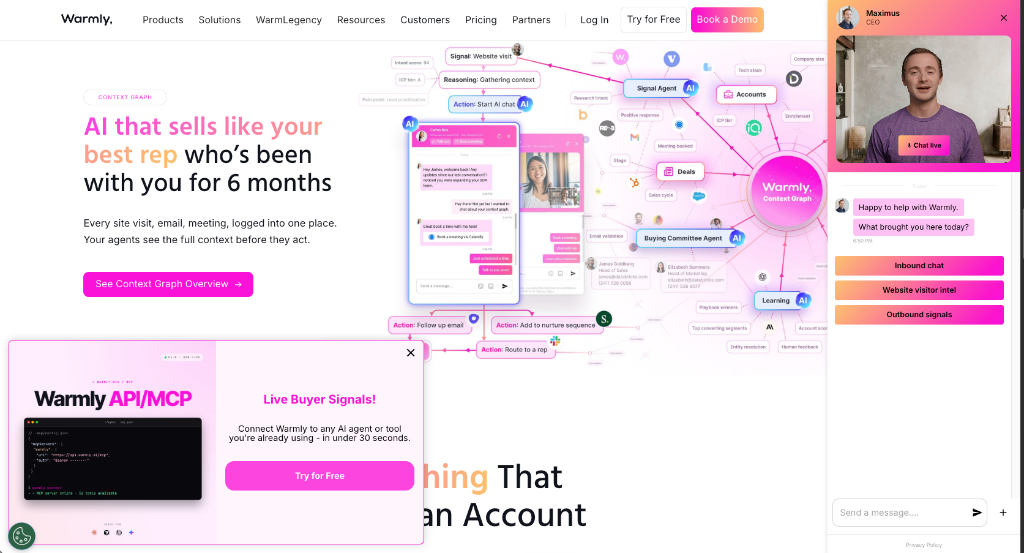
The popup is bold and on-brand: a pink gradient card with "Warmly API/MCP" and a code snippet on the left, "Live Buyer Signals!" on the right, the promise to "Connect Warmly to any AI agent or tool you're already using — in under 30 seconds," and a single "Try for Free" button. The result: high-intent visitors converted into self-serve sign-ups the moment they showed interest.
The MCP Release: Why a Popup Was the Right Channel
Warmly's MCP release was aimed at a technical buyer — revenue operations leaders, growth engineers, and teams already building AI agent workflows. These buyers don't want a sales call to evaluate a new integration. They want to read the docs, see the code, and try it themselves.
A website popup is the perfect channel for this audience because it meets them at the moment of peak interest — while they're on your site, evaluating your product — and offers a frictionless path to self-serve activation. No demo form. No sales sequence. Just "Try for Free."
The Results: 85% More Sign-Ups and Self-Checkout Adoption
The headline metric speaks for itself: an 85% increase in sign-ups attributable to the popup. But the more interesting outcome is the self-checkout adoption of the MCP feature.
Self-checkout — where a user signs up and activates a feature without ever talking to sales — is the holy grail of product-led growth. Warmly's popup made it possible by:
- Reducing activation friction: The "Try for Free" button takes visitors straight to signup, not a demo request form.
- Showing technical credibility: The code snippet on the left side of the popup signals to developers that this is a real, working API — not marketing fluff.
- Leading with the outcome: "Live Buyer Signals!" tells the buyer what they get, not what the feature is called.
- Addressing the integration objection: "In under 30 seconds" preemptively kills the "this will take too long to set up" objection.
Why Website Popups Outperform Email for Feature Launches
Most SaaS companies launch new features through email. The problem with email is that it's a passive, low-intent channel — your message competes with dozens of other emails, and the recipient has to context-switch from their inbox to your product.
A website popup is an active, high-intent channel. The visitor is already on your site, already evaluating your product, and already in a mindset of taking action. The popup converts that intent into a sign-up in a single click.
This is why Warmly's popup drove such a dramatic lift: it captured visitors who were already interested but hadn't been reached by the launch announcement, and gave them an immediate path to try the feature.
The Design Choices That Made the Popup Convert
Warmly's popup works because every element is optimized for conversion:
- Split-screen layout: The left side shows the product (code snippet), the right side sells the value ("Live Buyer Signals!"). This mirrors how technical buyers evaluate — they want to see the code and understand the benefit simultaneously.
- Pink gradient branding: Warmly's signature color creates instant brand recognition and visual consistency with the rest of their site.
- Single, clear CTA: "Try for Free" is the only action. No secondary links, no demo option — just one path to activation.
- Benefit-first copy: The headline leads with the outcome ("Live Buyer Signals!"), not the feature name. Visitors understand the value before they even process what MCP means.
- Speed promise: "In under 30 seconds" directly addresses the #1 objection to trying new developer tools — setup time.
The Self-Checkout Flywheel
The 85% sign-up increase is impressive, but the long-term impact is bigger. By driving self-checkout adoption, Warmly created a flywheel:
- More sign-ups → more users trying the MCP feature
- Self-serve activation → no sales bottleneck slowing adoption
- Faster time-to-value → users experience the feature's value immediately
- Higher retention → users who self-activate are more invested in the product
- More data → more usage signals to improve the feature
This is the product-led growth loop in action — and the website popup is the entry point that kickstarts it.
How to Replicate Warmly's Results-Driven Popup Strategy
With Upvert's Smart Popups, you can deploy the same results-driven feature launch popup strategy:
- Promote new features with a dedicated launch popup — don't bury your release in a blog post. Put it front and center for every website visitor during the launch window.
- Lead with the outcome, not the feature name — "Live Buyer Signals!" outperforms "Introducing MCP" because it tells the buyer what they get.
- Show the product visually — include a screenshot, code snippet, or GIF so technical buyers can evaluate credibility instantly.
- Use a single self-serve CTA — "Try for Free" or "Start Free" beats "Book a Demo" for feature adoption because it removes the sales friction.
- Address the setup-time objection — include a speed promise ("in under 30 seconds") to preempt the #1 objection to trying new tools.
- Target high-intent visitors — use website de-anonymization to show the launch popup only to visitors from target accounts or technical roles most likely to adopt.
Conclusion
Warmly's MCP release popup proves that website popups aren't just for lead capture — they're a primary go-to-market channel for feature launches. By meeting high-intent visitors with a contextual, self-serve activation offer at the moment of peak interest, Warmly drove an 85% increase in sign-ups and accelerated self-checkout adoption of its most important new feature.
The lesson: don't sleep on the popup. When you launch a new feature, your website is your highest-intent audience — and a well-designed popup is the fastest way to convert that intent into adoption.