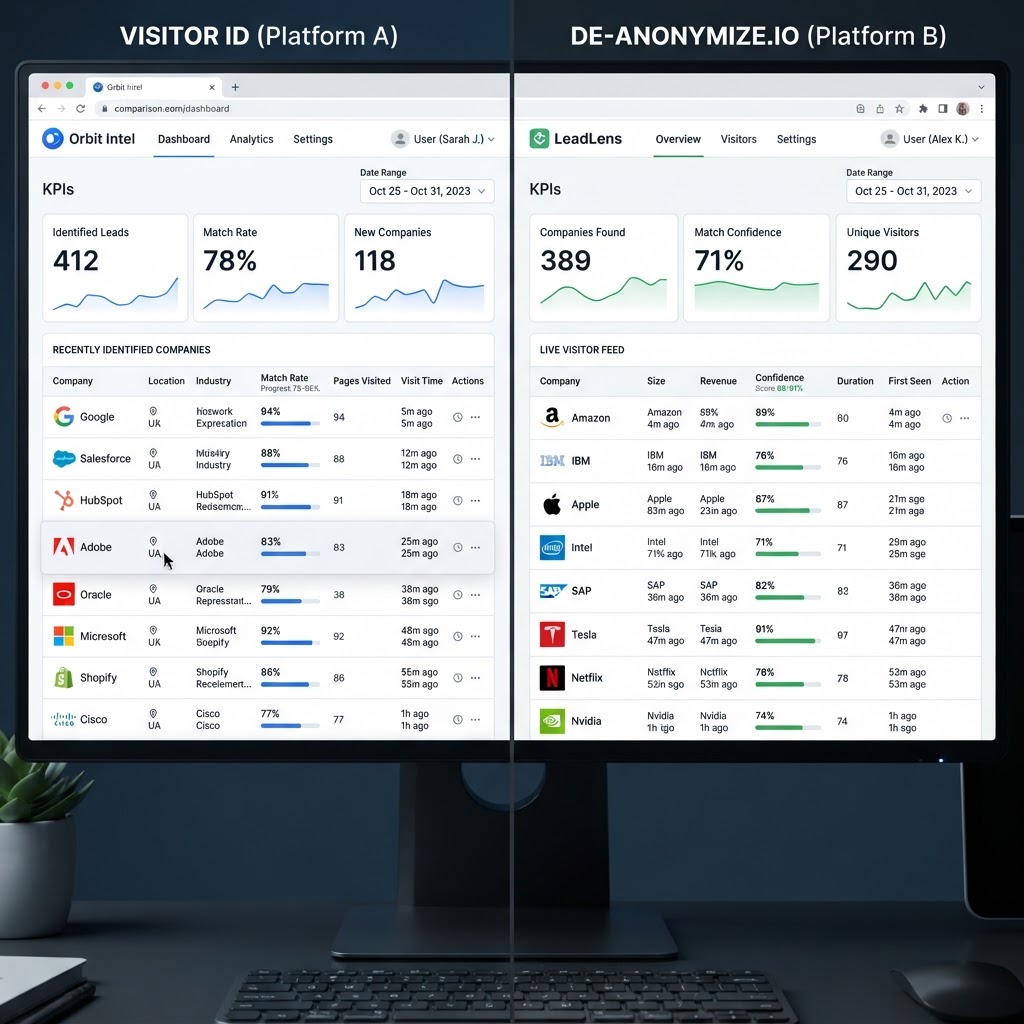
Upvert vs. Dealfront: Which Website De-Anonymization Platform Wins for B2B Teams in 2026?
Quick answer: Dealfront (formerly Leadfeeder) resolves website visitors primarily at the company level using IP-to-firmographic matching, which makes it a strong fit for European B2B teams operating under GDPR. Upvert pairs that same company-level resolution with person-level identification through its Warmly-powered identity graph, then automatically triggers personalized popups and microsites off the match — giving US-heavy and mixed-region teams a faster path from "who visited" to "who converted."
Both platforms solve the same core problem: roughly 96% of B2B website visitors never fill out a form, according to 2026 industry benchmarking, which means most of your traffic, ad spend, and content investment disappears into anonymous sessions. The question isn't whether you need website de-anonymization — it's which architecture actually turns that data into pipeline.
How Dealfront Identifies Visitors
Dealfront built its reputation on IP-to-company matching for European traffic, and it remains one of the stronger options for teams whose buyers sit in Germany, France, the Nordics, or the broader EU. Its match rates on company-level identification are competitive, but Dealfront stops at the account: it tells you which company is browsing, not which individual, and it does not natively personalize the page content those visitors see once identified.
How Upvert's De-Anonymization Works
Upvert layers three resolution methods — reverse IP/firmographic matching, cookie and device-graph signals, and a person-level identity resolution partnership with Warmly — to identify both the account and, where available, the individual. In practice this pushes blended identification rates into the 35–40% range on US-heavy traffic, well above IP-matching alone, because a meaningful share of B2B visitors now browse from home networks or mobile connections that don't resolve cleanly to a corporate IP.
Identification is only half the equation. Upvert's differentiator is what happens next: the moment a visitor is resolved, Upvert can fire an intent-triggered popup referencing their company by name, or route them to a personalized microsite built for their segment, industry, or deal stage — all without an engineer touching the page.
Person-Level vs. Company-Level: Why It Matters
Person-level identification is genuinely powerful for prioritizing outbound and personalizing outreach, but it's largely constrained to US traffic because of GDPR restrictions on individual tracking in the EU. Teams selling primarily into Europe will find Dealfront's company-level, compliance-first approach easier to defend internally. Teams selling primarily into the US, or running global motions where North America drives the majority of pipeline, typically get more actionable signal from Upvert's blended approach — you know not just that "Acme Corp" is on your pricing page, but that it's their VP of RevOps, on their third visit this week.
Pricing and Implementation
Dealfront's pricing scales with monthly identified companies and is typically positioned as a mid-market analytics tool rather than a full personalization stack. Upvert bundles de-anonymization with popups and microsites in a single platform, so teams comparing total cost of ownership should weigh it against buying a separate identification tool plus a separate personalization or A/B testing tool. Most Upvert customers report a live implementation — tracking script installed, first popups triggering off identified visitors — within 3 to 5 business days, without a services engagement.
Which Tool Fits Your GTM Motion
Choose Dealfront if your buyer base is majority-European, your primary use case is feeding identified-company data into your CRM for SDR prioritization, and you don't need in-the-moment page personalization. Choose Upvert if you want identification and action to happen in the same platform: spotting a target account, greeting them by name or industry with a triggered popup, and sending them to a microsite built for their use case — particularly useful for ABM programs and PLG teams converting free traffic into pipeline.
Is Dealfront the same company as Leadfeeder?
Yes. Leadfeeder rebranded to Dealfront after merging with Echobot in 2022, and the product still centers on IP-based company identification for website visitor tracking.
Does Upvert work for European traffic?
Yes, company-level identification works globally, including the EU. Person-level resolution is currently strongest in the US due to regional data availability and compliance frameworks.
What's a realistic de-anonymization match rate to expect?
Blended company- and person-level match rates commonly land between 20% and 40% depending on traffic source, industry, and region, with US B2B SaaS traffic typically at the higher end.
Can I use Upvert alongside my existing CRM?
Yes. Upvert integrates with HubSpot and Salesforce so identified visitors and their engagement data sync directly into existing pipeline and lead-routing workflows via native integrations.
How long does it take to see results after implementation?
Most teams see their first identified accounts and triggered popups within the first week, with measurable pipeline influence typically visible within 30 to 60 days as the identity graph builds history on repeat visitors.
Ready to see which visitors are actually landing on your site? Book a demo to compare Upvert's identification rates against your current tool, or explore the full Upvert vs. Dealfront comparison.